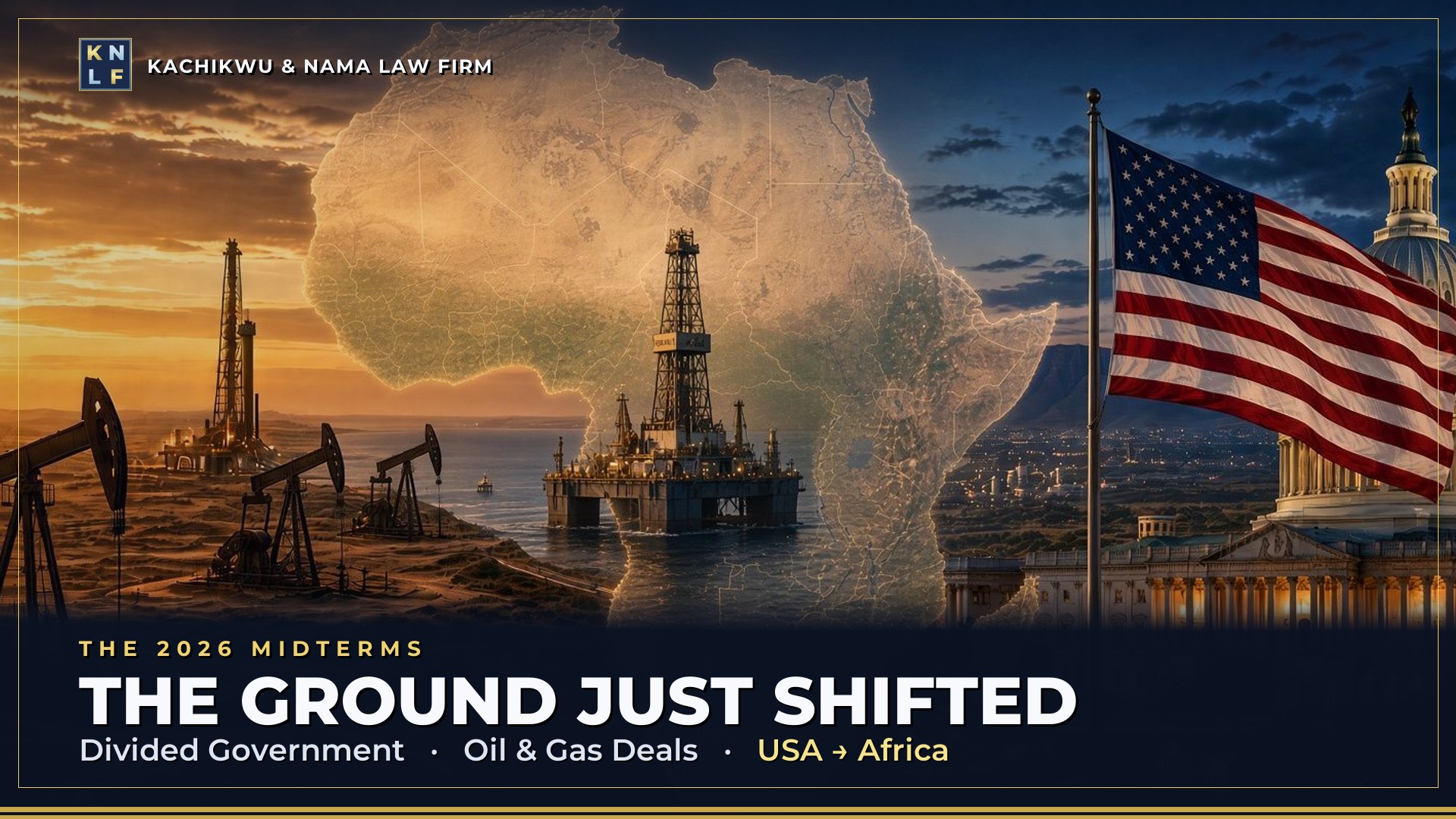
From Cape Town to Capitol Hill: What the 2026 Midterms Mean for Oil, Gas, and African Energy Deals
The commitments announced in Cape Town last month will be governed by a Washington that looks very different this month. For anyone deploying capital in oil and gas — from the Permian to the pre-salt — the variables just multiplied.
A neutral word, first. Some are celebrating these results; others are lamenting them. We are a law firm, not a political party — we do neither. Our job is narrower and more useful to you: to read how the legal, regulatory, and deal environment has changed, and to help you structure around it. For dealmakers, an election does not pick a winner — it resets the rules of uncertainty.
The bottom line
- Divided government means more friction and litigation — not a clean new direction.
- The IRA tax credits are legislatively locked, not suspended — the near-term risk runs through Treasury/IRS guidance, not repeal.
- The methane fee is off the table near-term (delayed to roughly 2034).
- U.S. public money for African energy already thinned in 2025 — diversify off any single U.S. program.
Cape Town set the pace
African Energy Week 2026 closed in Cape Town only weeks ago. As reported by the organizer, the African Energy Chamber — figures self-reported and unaudited, and these are commitments announced, not capital closed — the post-show tally included:
- $17 billion+ in commitments and new deals (of which about $16 billion sat in the 15-project Premier Invest Deal Room);
- 23 investment opportunities at the African Farmout Forum;
- 12,000 attendees and 1,500+ participating companies.
Landmark agreements followed, among them the African Energy Chamber–S&P Global five-year partnership, the Etu Energias–Chariot–BW Energy agreement, and the SANPC–SLB digital transformation partnership.
The thesis underneath it is familiar: Africa intends to use its gas to end energy poverty and industrialize — hydrocarbons as a development and transition fuel, not a stranded one. That thesis did not change when Washington did. The capital and policy weather around it did.
What actually changed in Washington
As projected by the Associated Press and major networks — and still subject to final certification — the 2026 midterms handed Democrats control of both the House and the Senate (CNBC; PBS NewsHour). But the fact that governs your planning is what did not change: the Republican White House remains, with the President in office through January 2029. Washington is now divided government — a Republican executive and a Democratic Congress pulling in different directions on energy.
In Texas, the night was historic without being a clean sweep (all results as projected, pending certification):
- The state's first Democratic governor since Ann Richards left office in January 1995;
- Democrats flipped the Texas House for the first time since 2002 (The Texas Tribune);
- A U.S. Senate seat flipped Democratic;
- But Republicans held the Texas Senate and the Railroad Commission — the state's principal oil-and-gas regulator.
The long Republican trifecta in Austin is broken; single-party control of Texas energy policy is not.
The new regulatory landscape: it is about how policy is made now
Divided government rarely produces sweeping statutes. It relocates power. Expect energy policy to move through five channels:
- Executive action and agency rulemaking. Leasing, permitting, and export approvals live largely with the executive — the "produce more" instinct has room to run here.
- The power of the purse. Congress holds the appropriations pen, but spending still needs the President's signature and, in the Senate, 60 votes — so the base case is funding fights, riders, continuing resolutions, and shutdown brinkmanship. For the U.S. International Development Finance Corporation (DFC) and the Export-Import Bank, the near-term pressure point is charter reauthorization and board quorum as much as annual dollars.
- Oversight and investigations. Committees now chaired by a new majority mean new hearings, subpoenas, and scrutiny of permits, contracts, and enforcement.
- Confirmations. A Democratic Senate shapes who runs the agencies and who sits on the courts.
- The courts. When legislation stalls, rules get litigated — more of the agenda settled by judges than by statute.
The translation for dealmakers: not a clean direction — more friction, slower certainty, more litigation. That is regulatory risk, and regulatory risk is priceable, hedgeable, and draftable.
In a deal right now? Before you lean on any federal program surviving the next budget fight, have counsel pressure-test your change-in-law and financing contingencies. Book a free consultation →
What it means for oil & gas worldwide
The big tax-credit changes already happened — in 2025. The One Big Beautiful Bill Act (July 2025) reshaped the Inflation Reduction Act credits under the prior Republican trifecta (Kirkland & Ellis; Sidley):
- §45Q (carbon capture) — preserved and enhanced; the survivor most relevant to oil, gas, and enhanced oil recovery.
- §45V (clean hydrogen) — cut back, ending for facilities that begin construction after December 31, 2027.
- §45X (advanced manufacturing) — pared, with component phase-outs.
- The near-term risk is now executive, not legislative — beginning-of-construction rules, recapture, transferability under §6418 (the regime that lets credits be sold), and the Act's new "prohibited foreign entity" limits on who may claim or buy transferred credits (Gibson Dunn). Model the guidance downside, not a repeal case.
With a Democratic Congress and a Republican White House now split, the credits are legislatively locked. Even budget reconciliation — the 51-vote path that enacted the 2025 changes — is off the table, because it still requires unified control of Congress and the presidency. For now, neither side can expand or repeal the credits through ordinary legislation.
Three more worldwide watch-points:
- The methane fee is on ice. Two things happened in 2025. First, Congress disapproved the EPA rule implementing the charge under the Congressional Review Act (signed March 2025), which also bars a substantially similar rule (Oil & Gas Journal). Second, the 2025 reconciliation law delayed the statutory Waste Emissions Charge itself by roughly a decade, to about 2034 (Congressional Research Service). The upshot: it is currently unenforceable — plan long-term, but do not price it into 2027 economics.
- LNG is a DOE + FERC + courts stack. Exports to non-FTA countries need DOE authorization; the facilities need FERC siting and construction approval; and NEPA (environmental-review) litigation attaches to both. A contested authorization can add real time — in our experience, an illustrative 6–18-month planning band, driven by the review and any appeals — so pad financing availability and commitment-fee assumptions accordingly.
- Sanctions and prices move on different tracks. Sanctions licensing (through the Treasury's Office of Foreign Assets Control, OFAC) is an executive lever — though relief is often Congress-constrained (for example, CAATSA requires a congressional review period before easing Russia sanctions). OPEC+ output, by contrast, is set by sovereign producers, outside Washington's control — so watch the two independently.
Africa in the crosscurrents
For companies doing business in Africa, this matters most — and the ground had already shifted before the midterms. U.S. public support for African power thinned in 2025: USAID was dissolved into the State Department (FurtherAfrica), and Power Africa was wound down after a decade (Africanews). What remains — chiefly the DFC and Ex-Im — now runs through the reauthorization, quorum, and oversight fights described above. The lesson is not to wait for Washington.
- Diversify the capital stack away from any single government's program: pair or replace U.S. DFC/Ex-Im exposure with Afreximbank, the African Development Bank, the IFC, export-credit agencies, Gulf and Asian capital, and commercial lenders. (National oil companies such as SANPC are principally sponsors, joint-venture partners, and offtakers — and may provide carry or prepayment financing — but are not a substitute for your lenders; structure them accordingly.)
- Insure the politics. Political-risk insurance — MIGA (World Bank Group), DFC insurance, and private cover — can allocate expropriation, currency-transfer, and breach-of-contract risk that contracts alone cannot reach.
- Screen hard for corruption exposure. Deals with state-owned NOCs carry heightened FCPA risk: an NOC, its officials, and offtake or agency intermediaries can be government instrumentalities or high-risk third parties. Screen counterparties and beneficial owners, add anti-corruption representations, warranties, and audit rights, and keep rigorous books-and-records controls.
- Build bankable, self-standing structures. The energy-poverty-versus-climate debate that animated Cape Town now meets a cooler reception in parts of Washington — which only sharpens the case for deals that stand on their own commercial merits, independent of the U.S. political cycle.
Financing or de-risking an African energy project? We structure cross-border deals that do not depend on one government staying put. Talk to us → or WhatsApp +1 832 840 7266.
Texas: relative insulation
Texas's oil and gas sits on private mineral rights and is regulated primarily at the state level by the Railroad Commission, which did not change hands. Split government in Austin points toward gridlock on major new state energy legislation — which, for existing operations, usually means continuity. Federal shifts matter at the margins (LNG permitting, federal-lands activity); the Texas model is comparatively buffered from Washington's swings.
Capital, deals, and investment strategy — what the smart money does now
In an adversarial policy environment, the edge goes to those who structure for optionality:
- Diversify capital sources so no single government program is a point of failure.
- Price in timeline risk — pad permitting and financing schedules for litigation and slower approvals.
- Favor stable frameworks — state-level regimes (Texas) and strong host-government agreements abroad.
- Stress-test credit-dependent returns against transferability (§6418), recapture, prohibited-foreign-entity eligibility, and sunset scenarios.
- Hedge the political cycle, not a political side — the goal is a deal that performs whoever is in power.
Before you sign
Before you commit capital, pressure-test:
- Change-in-law and stabilization clauses — who bears the cost when the rules move?
- Financing contingencies and MAC clauses that do not hinge on one government's program surviving.
- Permitting condition-precedents with realistic, litigation-aware timelines.
- Tax-credit terms — transferability (§6418), recapture, and prohibited-foreign-entity eligibility, with a modeled downside.
- Sanctions and FCPA compliance calibrated to a shifting enforcement posture.
- Offtake and currency structuring for African gas — the buyer's purchase commitment and the currency it settles in, local and export.
- Political-risk insurance — MIGA, DFC, or private cover where contracts cannot reach.
- Dispute resolution — ICSID where a bilateral investment treaty supplies consent (some jurisdictions, including South Africa, are not ICSID contracting states), or a neutral seat under ICC, UNCITRAL, or LCIA rules where it is not.
We do not predict politics. We help you build deals that survive whichever way policy turns.
Frequently asked questions
What do the 2026 U.S. midterms mean for the oil and gas industry?
Divided government — a Democratic Congress with a Republican White House through January 2029 — means more friction, slower certainty, and more litigation rather than a clean new direction. Energy policy shifts to executive action, the appropriations process, oversight, confirmations, and the courts.
Did the 2026 election change the Inflation Reduction Act energy tax credits (45Q, 45V, 45X)?
The major changes came in 2025 under the One Big Beautiful Bill Act, which preserved and enhanced Section 45Q (carbon capture), cut Section 45V (hydrogen), pared Section 45X, and added prohibited-foreign-entity limits. With divided government the credits are now legislatively locked; the near-term risk runs through Treasury/IRS guidance, not repeal.
How do the 2026 midterms affect U.S. financing for African energy projects?
U.S. public support already thinned in 2025 — USAID was dissolved into the State Department and Power Africa was wound down — and the DFC and Ex-Im Bank now face reauthorization and oversight fights. Investors should diversify capital sources (Afreximbank, the African Development Bank, the IFC, export-credit agencies, Gulf and Asian capital) and use political-risk insurance.
What should oil and gas investors check before signing a deal now?
Change-in-law and stabilization clauses, financing contingencies not tied to a single government program, permitting condition-precedents, tax-credit transfer/recapture and prohibited-foreign-entity terms, sanctions and FCPA compliance, political-risk insurance, and the right dispute-resolution forum.
About the author
Georges Nama, Esq. is Co-Founder and Managing Partner of Kachikwu & Nama Law Firm (KNLF) in Texas. He is an oil and gas and cross-border attorney, a member of the State Bar of Texas, and works in English, French and Spanish. He began his career in Libreville at Cabinet Issembé, legal counsel to the Government of Gabon, and has since led French–English contract negotiations for oil and gas companies worldwide. He is a member of the Association of International Energy Negotiators (AIEN). He holds a Post-Juris Doctor Law Degree (LL.M.) from the University of Houston Law Center and a Maîtrise en Droit from University Cheikh Anta Diop of Dakar.
Kachikwu & Nama Law Firm advises companies and investors on U.S. business matters and Africa–U.S. deals: energy agreements, cross-border transactions, contracts, entity structuring, real estate and investment-related immigration. Georges co-founded the firm in May 2025 with Prof. Emmanuel Ibe Kachikwu, former Nigerian Minister of State for Petroleum Resources, former President of OPEC and former Group Managing Director of NNPC.
Contact: [email protected] · www.kn-laws.com
Negotiating a transaction, financing, or project touched by this shift — in Texas, across the United States, or in Africa and the Middle East? Book a free 30-minute consultation — we reply within one business day. Explore our work in Oil, Gas & Energy, Africa–U.S. Transactions, and Outside General Counsel, or message us on WhatsApp +1 832 840 7266. This article is general information, not legal advice; election results are provisional pending certification, and tax, sanctions, and financing positions should be confirmed against current law before you act.
The ground just shifted. Let's pressure-test your deal before you sign.
Book a consultation Oil, Gas & Energy Africa–U.S. Transactions Outside General Counsel
Comments
Join the discussion. Comments are reviewed by the firm before they appear.
No comments yet. Be the first to share your perspective.