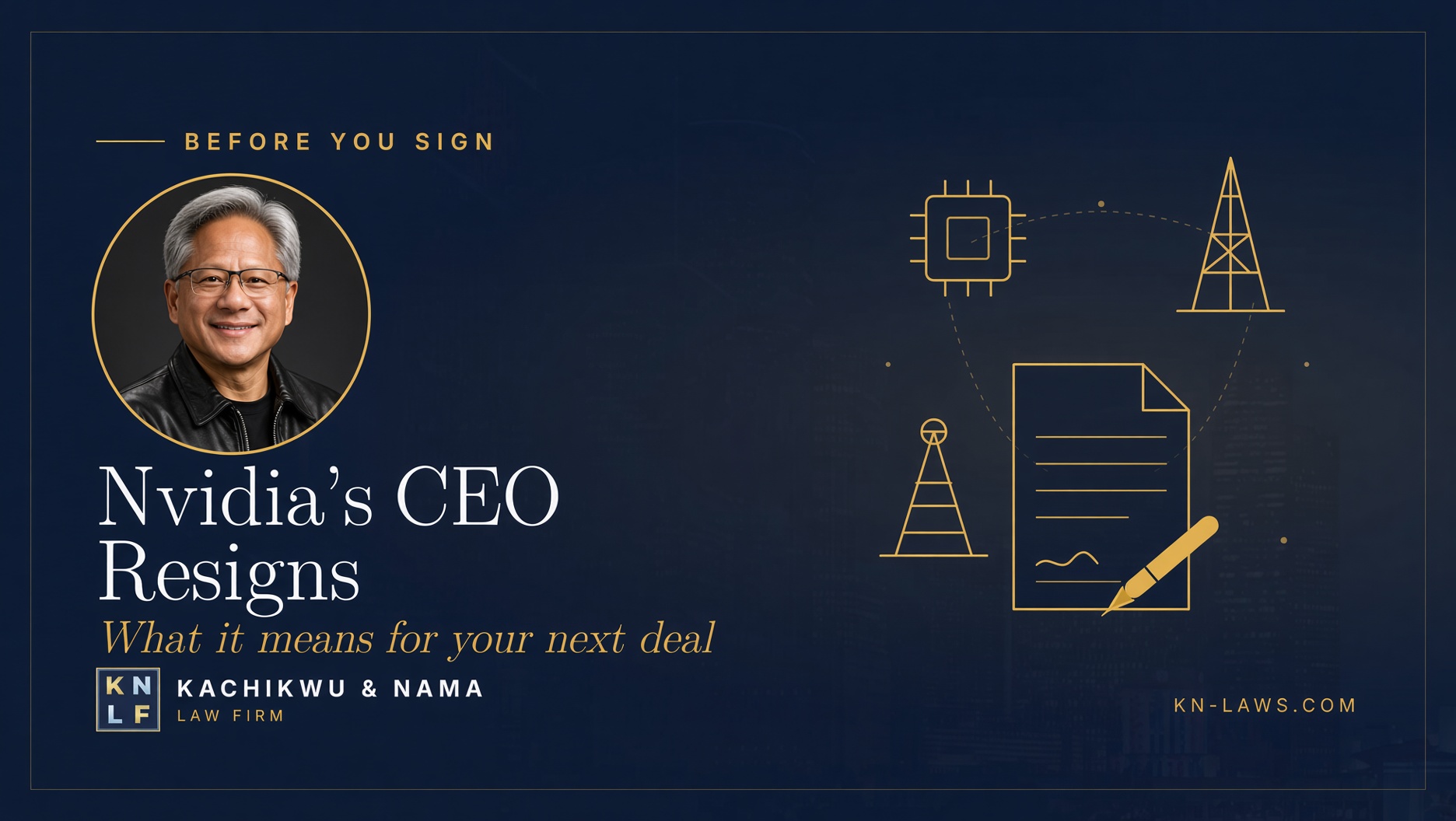
Know Who Sits Across the Table
This morning, the board of the world’s most valuable chipmaker announced that its chief executive had resigned, effective immediately. I will leave the cause of that resignation, and the personal side of the story, to the people involved. The business lesson belongs to all of us who negotiate deals for a living — and it reaches far beyond Silicon Valley.
Advanced chips have become strategic assets. So have the barrels, molecules and minerals that power and build them.
Every AI data center runs on electricity, and the chips and hardware that fill it lean on copper, cobalt and rare earths — much of the world’s cobalt and copper mined in Africa. The supply chains of the digital economy now run straight through the oil field, the gas plant and the mine. When an asset becomes strategic, the questions around a deal change: it is no longer enough to ask what you are buying and at what price. You must also ask who you are really dealing with, where the product will end up, and what happens if the people behind the deal walk away. Oil, gas and mining companies have lived with these questions for decades. Here is what I look for before a client signs.
1. Know your counterparty — and who stands behind it
A name on a signature page tells you very little. Behind it may sit a holding company in one country, a beneficial owner in another, and sometimes a person a sanctions list has something to say about. Beneficial-ownership disclosure, sanctions screening and politically-exposed-person checks are not box-ticking — they decide whether your deal is legal and whether your bank will touch it. The U.S. Treasury’s Office of Foreign Assets Control maintains the sanctions lists, and its “50 percent rule” can block an entity that a sanctioned party owns only indirectly. In a Texas farm-out, an African production sharing contract or a mineral offtake, the ownership and compliance representations should be specific, backed by a disclosure schedule, and true on every day of the contract — not only at signing. Tie them to a continuing covenant and a right to walk if they stop being true.
2. Control where the product ends up
Export controls and sanctions follow the goods, not the invoice. The same logic that decides where an advanced chip may ship — administered for U.S. exports and re-exports by the Bureau of Industry and Security under the Export Administration Regulations — decides where crude, LNG and critical minerals may flow. A buyer who diverts your product to a prohibited end-user can put you in the regulator’s sights even if you never touched the diversion. Your contract should carry clear end-use and re-export undertakings, documentary proof (end-use certificates, delivery evidence), a real right to audit the chain, and a right to suspend the next cargo or terminate if a breach is suspected.
3. Plan for a change of control — or of the key person
Many deals rest on one relationship: a founder, a chief executive, a trusted counterpart. This week is a reminder that the person who made the deal possible can be gone by the next quarter. Change-of-control clauses, consent rights over assignment, and key-person provisions turn unwritten trust into written protection. Decide in advance what happens if your counterparty is acquired, if control passes to a party you would never have chosen, or if the individual you relied on departs — a consent right, a right of first refusal, a price adjustment, a clean way out. Material-adverse-change and key-person covenants give you leverage at the exact moment you would otherwise have none. In cross-border and African deals, where relationships and government interfaces carry real weight, that is not sentiment — it is risk allocation.
4. Write compliance into the deal
Anti-corruption, books-and-records and cooperation clauses protect both sides when regulators start asking questions — and today, they do ask. The U.S. Foreign Corrupt Practices Act reaches conduct far beyond U.S. borders, and its accounting provisions demand accurate books and internal controls; the U.K. Bribery Act reaches further still. A strategic-asset contract should require each side to comply with applicable anti-corruption law, keep accurate records, refuse unlawful payments, permit audit, and cooperate — within privilege — if an investigation comes, all backed by representations, a right to terminate for breach, and an indemnity. In African transactions, where local-content rules, state participation and public counterparties are common, clean compliance drafting is what lets a Western investor and its lenders proceed with confidence.
5. Know how you will exit
The best time to negotiate the end of a deal is the beginning, when everyone is still friends. Termination rights, dispute-resolution and governing-law clauses decide how you leave a deal that has gone wrong — and whether the paper you hold is worth anything when you do. Choose a governing law that fits the deal (common law or OHADA — not whichever boilerplate was nearest), and a forum that yields an enforceable award: for a commercial dispute, international arbitration under the ICC or LCIA, seated somewhere neutral, with the New York Convention behind it; where the deal gives you a treaty claim against the host state, ICSID. Spell out the triggers, the notice-and-cure, and the consequences — what you keep, what you return, what you are owed — and, for projects exposed to the host state, how a change in the law is handled (our work on the KNLF Stability Compact goes deeper there). A clean exit drafted on day one is cheaper than any dispute.
None of this is glamorous. The strongest protection for a strategic asset is still the least glamorous one: good governance, written into good contracts. The chip story will fade from the headlines; the lesson will not. Before you sign, know the law — or at least be well advised.
At KNLF, we draft and negotiate the farm-outs, production sharing contracts, offtake and mineral agreements behind strategic-asset deals — in oil, gas & energy, mining & critical minerals and Africa–U.S. transactions — and we serve as your outside general counsel when you want it done continuously. Book a consultation before your next deal, not after.
Every Monday, we break down Africa–U.S. oil and gas news in the Oil & Gas Intelligence Brief.
Comments
Join the discussion. Comments are reviewed by the firm before they appear.
No comments yet. Be the first to share your perspective.