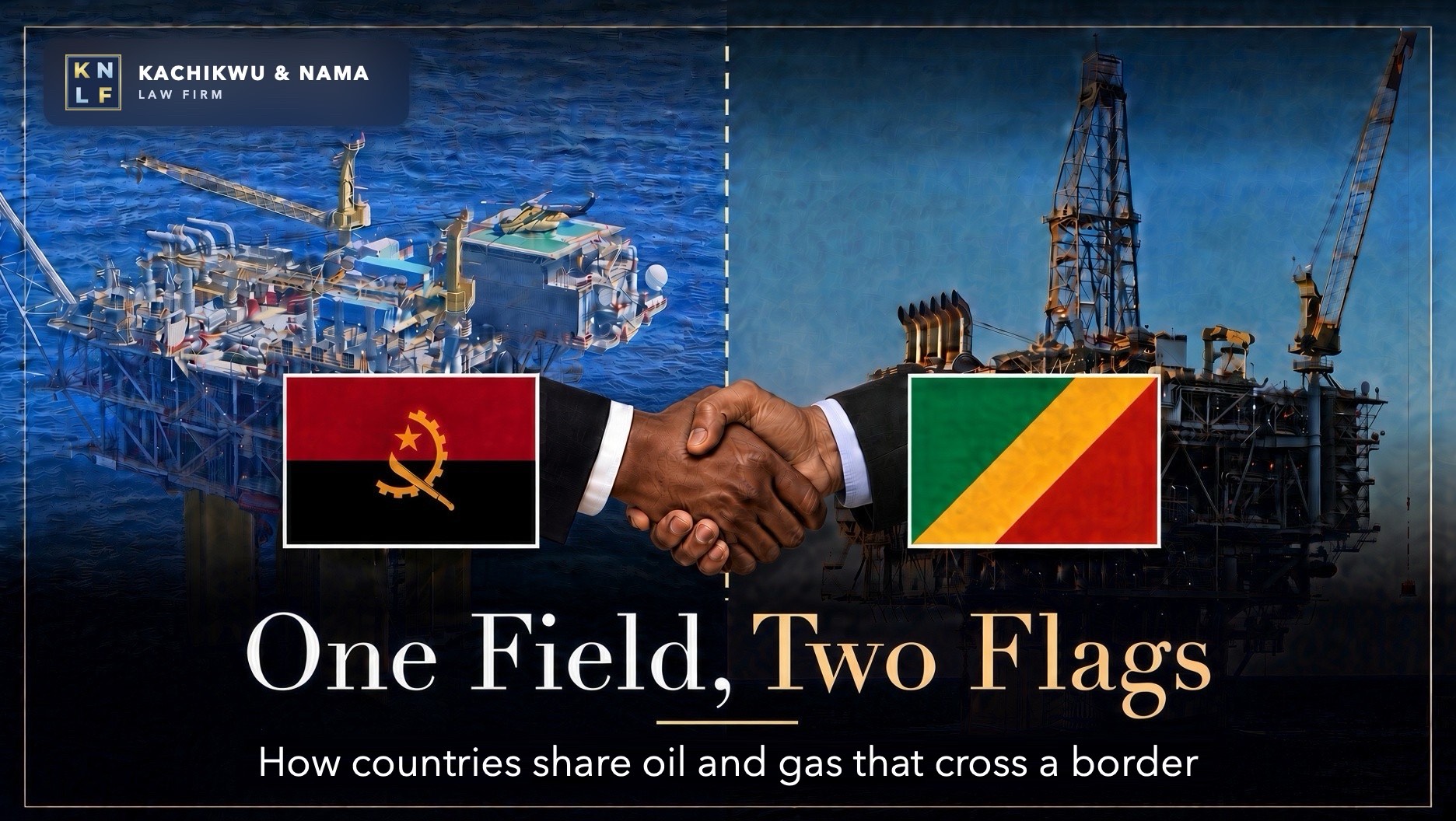
One Field, Two Flags: How Countries Share Oil and Gas That Cross a Border
On the morning of September 30, 2026, a delegation from Trident Energy Congo sat down in Luanda with ANPG, Angola’s petroleum agency. The subject was one oil field, Lianzi, and a question that sounds simple: how do two countries go on sharing it now that the operator on one side has changed?
Oil and gas do not follow borders. A line on a map does not stop fluid from moving underground. When a field lies under two countries, the two states have three choices: race each other, fight, or share.
ANPG’s chairman, Paulino Jerónimo, described the meeting as a discussion of “the unitization and development of the Lianzi Field,” an asset shared between Angola and the Republic of Congo. Trident had taken over the Congolese side after buying the position Chevron held there (ANPG, Trident Energy). This article explains how sharing works: what international law requires, the two legal models states use, how the contracts are layered, and what an investor should check before buying into a field with two flags over it. Lianzi is the starting point; the lessons reach from Senegal to Timor.
What international law requires
International law gives each coastal state sovereign rights over the oil and gas of its continental shelf. It does not say what happens when one deposit lies under two shelves. The answer has been built from treaty text, court decisions and decades of state practice.
No rule of capture between states. Under the old common-law rule of capture, whoever drills first may keep what flows to the well. States have not accepted that rule between themselves. As early as 1969, the International Court of Justice noted in the North Sea Continental Shelf cases that a deposit lying on both sides of a line can be exploited from either side, and pointed to agreements for joint exploitation as the answer.
A duty to cooperate where no boundary is agreed. Articles 74(3) and 83(3) of the UN Convention on the Law of the Sea apply while two states have not yet agreed a boundary. They impose two obligations: the states must “make every effort to enter into provisional arrangements of a practical nature,” and they must not “jeopardize or hamper” a final agreement. Any such arrangement is without prejudice to the final boundary.
What that duty means in practice. In Guyana v. Suriname (2007), an arbitral tribunal applied those articles to oil activity in a disputed area. Its reasoning is widely read as drawing a line between two kinds of activity: seismic surveys, which leave no permanent mark, were not inconsistent with the duty on the facts of that case; exploratory drilling, which changes the seabed permanently, was. The tribunal found both states in breach — Guyana for authorizing drilling, Suriname for answering with a threat of force.
A warning from West Africa. In Ghana/Côte d’Ivoire, a Special Chamber of the International Tribunal for the Law of the Sea ordered in April 2015 that Ghana ensure no new drilling took place in the disputed area while the case ran. The TEN project, already well advanced, was allowed to continue. The 2017 judgment drew the boundary and found that Ghana had not violated Côte d’Ivoire’s rights (Debevoise summary). For two years, though, an operator with a signed contract could not drill new wells.
The practical lesson is that a licence from one state is only as good as that state’s title to the seabed. Where title is shared or disputed, the investor needs both states inside the deal.
Two models: unitization and joint development
States use two main models. Which one applies depends on a single question: is there an agreed boundary?
| Cross-border unitization | Joint development zone | |
|---|---|---|
| Boundary | Agreed. The field happens to cross it. | Not agreed, or deliberately set aside. |
| What is shared | One field, treated as a single unit. | A whole area and everything found in it. |
| Whose law applies | Each state’s law on its own side, coordinated by treaty. | A special regime, often with a joint authority. |
| Who licenses | Each state licenses its side. | The joint authority, or both states together. |
| Sharing formula | Based on how much of the reservoir lies on each side, often open to redetermination. | Fixed by political agreement, such as 50/50 or 60/40. |
| Examples | Frigg (UK and Norway), Greater Tortue Ahmeyim (Senegal and Mauritania). | Nigeria and São Tomé and Príncipe, Senegal and Guinea-Bissau, Malaysia and Thailand. |
The difference matters to an investor. In a unitization, the company keeps its contract with its own host state, and a treaty sits above the contracts to coordinate them. In a joint development zone, the company often contracts with a body created by the two states, under rules written for that zone alone. Many real arrangements are hybrids. Lianzi is one of them.
Lianzi: one field between Angola and Congo
Lianzi sits in a zone the two governments created in the early 2000s to end a border dispute. The zone is called 14K/A-IMI. It joins the 14K area of Angola’s Block 14 with the A-IMI area of Congo’s Haute Mer permit, covers 696 square kilometres, and is shared 50:50 between the two countries (Oil & Gas Journal, 2004; Wood Mackenzie).
The structure. The two states did not create a new authority or a new contract. Each half of the zone stayed under its own production sharing contract — one Angolan, one Congolese — and whatever is found is split equally between the two contracts. That makes Lianzi a hybrid: the zone was born from a boundary dispute, like a joint development zone, but it runs through two national contracts, like a unitization.
The field. Chevron discovered Lianzi in 2004 and brought it into production in November 2015, calling it the first cross-border oil development offshore Central Africa. The field lies 105 kilometres offshore in about 900 metres of water. It has no platform of its own: a 43-kilometre heated flowline carries the oil to the Benguela Belize-Lobito Tomboco platform in Angola’s Block 14 (Oil & Gas Journal, 2015; The Energy Year).
The partners at start-up. Eight companies shared the field in 2015:
| Company | Interest |
|---|---|
| Total E&P Congo | 26.75% |
| Chevron Overseas (Congo), operator | 15.75% |
| Cabinda Gulf Oil Company (Chevron’s Angolan affiliate) | 15.5% |
| Angola Block 14 BV | 10% |
| Eni | 10% |
| Sonangol P&P | 10% |
| SNPC (Congo’s national oil company) | 7.5% |
| Galp | 4.5% |
What changed. In 2025 Trident Energy bought Chevron’s Congolese business and became operator of Lianzi with the same 15.75% interest (Trident Energy). The Angolan side is changing too: in August 2026 the Angolan company Etu Energias announced an agreement to buy the interests of Chevron’s Angolan affiliate in Block 14 and in the 14K area, with closing expected in early 2027 (World Oil). The oil still flows to a platform in that Angolan block. So the field has a new operator on the Congolese contract, and the block that hosts its only export route is itself about to change hands. Interests have moved since 2015, and readers should confirm today’s holders before relying on the table above.
That is why a Congolese operator went to Luanda. A shared field cannot be run from one capital; every decision about further development needs the regulator on the other side of the line.
Africa’s other shared fields and zones
Lianzi is one of several African arrangements. They differ in structure, and their results differ just as much.
| Arrangement | States | Year | Model | Split |
|---|---|---|---|---|
| Greater Tortue Ahmeyim | Senegal and Mauritania | 2018 | Cross-border unitization | 50/50, open to redetermination |
| Joint Development Zone | Nigeria and São Tomé and Príncipe | 2001 | Joint development zone | 60/40 |
| AGC joint zone | Senegal and Guinea-Bissau | 1993 | Joint development zone | 85/15 for hydrocarbons at signing |
| Maritime boundary treaty and protocol | Nigeria and Equatorial Guinea | 2000 and 2002 | Boundary with a straddling-field clause | Field by field |
| Zone of Common Interest | Angola and DR Congo | 2007 | Joint zone with one contract | Under the 2023 contract |
| 14K/A-IMI (Lianzi) | Angola and Republic of Congo | Early 2000s | Hybrid | 50/50 |
Senegal and Mauritania: the model that reached production. The two governments signed an Inter-Government Cooperation Agreement in Nouakchott on February 9, 2018. It develops the Greater Tortue Ahmeyim gas field as a single unit, with an initial 50/50 split of resources and revenues and a mechanism for later redetermination (bp). Senegal’s ratification law describes the split as provisional and allows a first redetermination after five years of commercial production (Loi n° 2018-21). The treaty came before the investment decision, and the project was built.
Nigeria and São Tomé and Príncipe: the zone that stalled. A treaty signed in Abuja on February 21, 2001 created a Joint Development Zone over overlapping claims. Resources are shared 60% to Nigeria and 40% to São Tomé and Príncipe. The treaty runs for 45 years with a review after 30, and neither state gives up its claim (Joint Development Authority). The zone raised large signature bonuses early on, but no field has reached production, and press reports have described the Authority’s difficulties (The Guardian Nigeria). The legal structure was sound; the geology and the administration did not deliver.
Senegal and Guinea-Bissau: the split that would not hold. The agreement of October 14, 1993 ended a case before the International Court of Justice (ICJ). It created a joint zone run by an agency in Dakar, with fish shared 50/50 and continental-shelf resources shared 85% to Senegal and 15% to Guinea-Bissau (treaty text, UN). That ratio has been contested in Guinea-Bissau ever since (Petroleum Economist), and the matter is not settled: a 2021 accord moving the split to 70/30 was rejected by Guinea-Bissau’s parliament that December. A sharing formula that one side comes to see as unfair becomes a political risk for every investor in the zone.
Nigeria and Equatorial Guinea: the clause in the boundary treaty. The two states agreed a maritime boundary on September 23, 2000. The treaty itself provides that where the line runs through a hydrocarbon deposit, the two states shall seek appropriate unitization arrangements, and a protocol of April 2, 2002 implements that clause (treaty text, UN; UN treaty record). This is the cleanest sequence: draw the line first, and write the sharing rule into the same instrument.
Angola and DR Congo: sixteen years from zone to contract. The Zone of Common Interest was created in 2007. A production sharing agreement for Block 14/23 inside it was signed only on December 21, 2023, with Chevron’s affiliate as operator holding 31% (Chevron). Agreeing to share is one step; agreeing the contract is another, and it can take far longer.
Where sharing failed, courts drew lines. Ghana and Côte d’Ivoire went to the Law of the Sea Tribunal, as described above. Somalia and Kenya went to the International Court of Justice, which delimited their boundary in October 2021. Gabon and Equatorial Guinea asked the same court which legal titles govern their boundaries and three islands; its judgment of May 19, 2025 answered that question and left the delimitation itself to the two states. Litigation produces a line. It does not produce a development plan, and it can freeze investment for years.
Lessons from outside Africa
Four arrangements elsewhere show how the same problem has been solved under different legal traditions.
The North Sea: Frigg. The Frigg gas reservoir straddles the median line between the United Kingdom and Norway. Norway feared that whoever started first could drain the whole reservoir. The two governments signed a treaty on May 10, 1976 providing that the gas “shall be exploited as a single unit.” An independent consultant proposed how the reserves divided between the two sides, the licensees and both governments accepted it, and the treaty became the template for later North Sea fields (Norwegian Petroleum Museum).
The Timor Sea: Greater Sunrise. Australia and Timor-Leste signed a boundary treaty on March 6, 2018. It draws the line and, in the same instrument, creates a special regime for the Greater Sunrise fields. Upstream revenue is shared 70/30 in Timor-Leste’s favour if the gas is piped to Timor-Leste, and 80/20 if it is piped to Australia (treaty text; Annex B). The sharing formula is tied to where the investment lands.
The Gulf of Thailand: the Malaysia-Thailand Joint Authority. The two states signed a memorandum on February 21, 1979 to exploit an area of overlapping claims together, and an agreement of May 30, 1990 created the Joint Authority that runs it (1990 Agreement). Resources are shared equally. The boundary question was set aside and the area has produced gas since the mid-2000s.
The Gulf of Mexico: the United States and Mexico. The Transboundary Hydrocarbons Agreement was signed at Los Cabos on February 20, 2012 and entered into force on July 18, 2014 (BOEM). It sets a framework under which U.S. leaseholders and Mexico’s national oil company may unitize a reservoir that crosses the boundary, with both governments approving any unit agreement. A U.S. operator already works under this model at home — which makes it a familiar reference point when the same operator negotiates in Africa.
How the arrangements are built: four layers
A shared field rests on four layers of documents. Each has different parties and a different governing law.
- The treaty between the two states. It defines the area or the field, states how production and costs are shared, sets up any joint commission or authority, and says how the two states will settle disputes between themselves. It is governed by international law.
- The host government contracts. Each company still holds its rights under a production sharing contract or licence with one state, or with the joint authority. These contracts are governed by national law, and they must be amended so that they recognize the unit.
- The unitization and unit operating agreement. The companies on both sides agree to develop the field as one, appoint a single unit operator, fix each party’s share of the unit, and set the rules for redetermining those shares. Both states approve it.
- The supporting agreements. These cover access to the host platform or pipeline, lifting and marketing, decommissioning security, and the customs and tax treatment of people and equipment that cross the line.
The fiscal layer runs through all four. Each state taxes its share under its own regime. The same dollar of cost must be recoverable on one side without being disallowed on the other, and the contracts have to say which state’s auditors may examine which costs.
Redetermination is the clause that moves money. The first split is an estimate. As wells are drilled, the partners learn where the reservoir actually lies. A redetermination clause lets the shares be recalculated, with a balancing payment in cash or in kind. The Senegal and Mauritania agreement allows this after five years of commercial production. A treaty with a fixed political split, such as 60/40, avoids the argument but may not match the geology.
Sharing without surrendering sovereignty
People often call these arrangements “shared sovereignty.” Lawyers should be careful with the phrase. In almost every case, neither state gives up sovereignty or its claim. What the states pool is narrower: the exercise of their sovereign rights over one resource, in one area, for a fixed time. Three drafting techniques make this possible.
- A without-prejudice clause. The treaty states that nothing in it affects either side’s legal position on the boundary. The Nigeria and São Tomé and Príncipe treaty says expressly that neither state renounces its claim to the zone. The Law of the Sea Convention builds the same protection into every provisional arrangement.
- A time limit. Joint zones run for a term, often several decades, with a review. The Nigeria and São Tomé and Príncipe treaty runs 45 years with a review at 30.
- A joint body with limited powers. A commission or authority acts for both states inside the zone. It licenses, regulates and collects revenue. It does not own the seabed.
This matters for an investor in a practical way. A contract signed with a joint authority depends on the treaty that created the authority. If the treaty ends, is suspended or is renegotiated, the contract needs its own answer to the question of what happens next. A well-drafted contract says which state — or both — steps into the authority’s place. (Where the risk is that a government later changes the rules, our work on the KNLF Stability Compact sets out eight concrete contract tools.)
When one side changes operator
The Lianzi meeting in Luanda raises a question that treaties rarely answer in detail: what happens to a shared field when a company on one side sells? A buyer in that position should expect five issues.
- Consent on its own side. The host state whose contract is being transferred will almost always have a right to approve the transfer or the change of control. In many African petroleum laws a sale of the shares of the contract holder is treated like a sale of the interest itself.
- Consent across the line. The treaty or the unit agreement may require that the other state, or the joint body, approve a new unit operator. Even where it does not, the other regulator approves budgets and development plans, so its goodwill is needed in practice.
- Partners’ rights. The unit operating agreement may give the other partners a right of first refusal, or a vote on who operates. Operatorship does not always pass with the interest; it may have to be confirmed by the partners.
- Dependence on the seller. Where the field produces through facilities on the other side, the buyer needs the facility owner’s agreement on tariffs, capacity and priority. At Lianzi the host platform sits in an Angolan block.
- Old liabilities. Cost-recovery balances, tax audits and decommissioning obligations built up under the seller. The sale agreement must say who carries them, and each state must accept that allocation for its own side.
A transaction that closes cleanly in one capital can still stall in the other. The careful buyer runs the two approval tracks in parallel and makes both conditions of closing — the kind of cross-border deal work we handle as Africa–U.S. transactions counsel.
Two legal systems, three languages
A shared field multiplies a risk that exists in every cross-border contract: the same words can carry different legal meaning on each side.
At Lianzi, Angola’s side is governed by Angolan petroleum law and written in Portuguese. Congo’s side is governed by Congolese law, written in French, with the business law of the OHADA system behind it. The companies negotiate among themselves in English, usually on forms drawn from common-law practice. Three languages and three legal traditions meet in one reservoir. The same pattern appears elsewhere: the 1993 agreement between Senegal and Guinea-Bissau joins a French-speaking and a Portuguese-speaking state; Nigeria’s treaty with Equatorial Guinea was made in English and Spanish, both texts equally authoritative; Nigeria and São Tomé and Príncipe pair a common-law state with a Portuguese civil-law state. Three points deserve attention in the drafting.
- Which text controls. If two language versions are both authoritative, a difference between them is a dispute waiting to happen. The contract should name one controlling text, or set a rule for resolving differences.
- Terms with no equivalent. A common-law phrase such as “best efforts” does not map neatly onto civil-law categories of obligation. Concepts such as force majeure, hardship and gross negligence also differ between French, Portuguese and English law.
- Who is doing the legal reading. A translator converts words. Only a lawyer trained in both systems can say whether the clause will mean the same thing before a court or tribunal on each side of the line.
This is exactly the ground a firm that works in English, French and Portuguese is built to cover — in oil, gas & energy agreements and across the Africa–U.S. deals that depend on them. We examine that gap clause by clause in One Contract, Two Legal Worlds.
Before you sign: ten questions for a shared field
- Is there an agreed boundary, a joint zone, or an open dispute? Read the treaty itself.
- Is the treaty in force in both states? Signature is not ratification.
- Who granted the rights you are buying: one state, the other, or a joint body?
- How are production and costs split, and can the split be redetermined? When, by whom, and with what payment?
- Whose consent does a transfer or change of control require: one state, both, the joint body, the partners?
- Who is the unit operator, and how can the operator be replaced?
- Where does production physically go, and who controls that route?
- Which tax regime applies to which costs, and will both states recognize the same expenditure?
- Which language version of each document controls, and has a lawyer trained in each system read it?
- Where are disputes heard at each level: state against state, company against state, company against company?
One field, one understanding
The geology of a shared field is the same on both sides of the line. The law is not. The arrangements that have worked, from Frigg to Greater Tortue Ahmeyim, have three things in common: the states agreed the framework before the money was spent; the sharing formula could adjust to what the wells later showed; and every party read the same contract the same way. The meeting in Luanda was a small event, but it shows the point well. A change of owner on one side of a line is a legal event on both sides.
Georges C. Nama, Esq., is Managing Partner of Kachikwu & Nama Law Firm, LLP, a Texas law firm advising on oil, gas and mining transactions between the United States and Africa. The firm works in English, French and Portuguese.
General information only, not legal advice. Each arrangement described here turns on the text of its own treaty and contracts, which should be read in full before any decision is made.
At KNLF, we structure and negotiate the treaties-behind-the-contracts work of shared fields — unitization and joint-operating agreements, host-government contracts and change-of-control consents — in oil, gas & energy and Africa–U.S. transactions, and we serve as your outside general counsel when you want it done continuously. Book a consultation before you buy into a field with two flags over it.
Every Monday, we break down Africa–U.S. oil and gas news in the Oil & Gas Intelligence Brief, and we publish deal-side guidance in Before You Sign.
Comments
Join the discussion. Comments are reviewed by the firm before they appear.
No comments yet. Be the first to share your perspective.