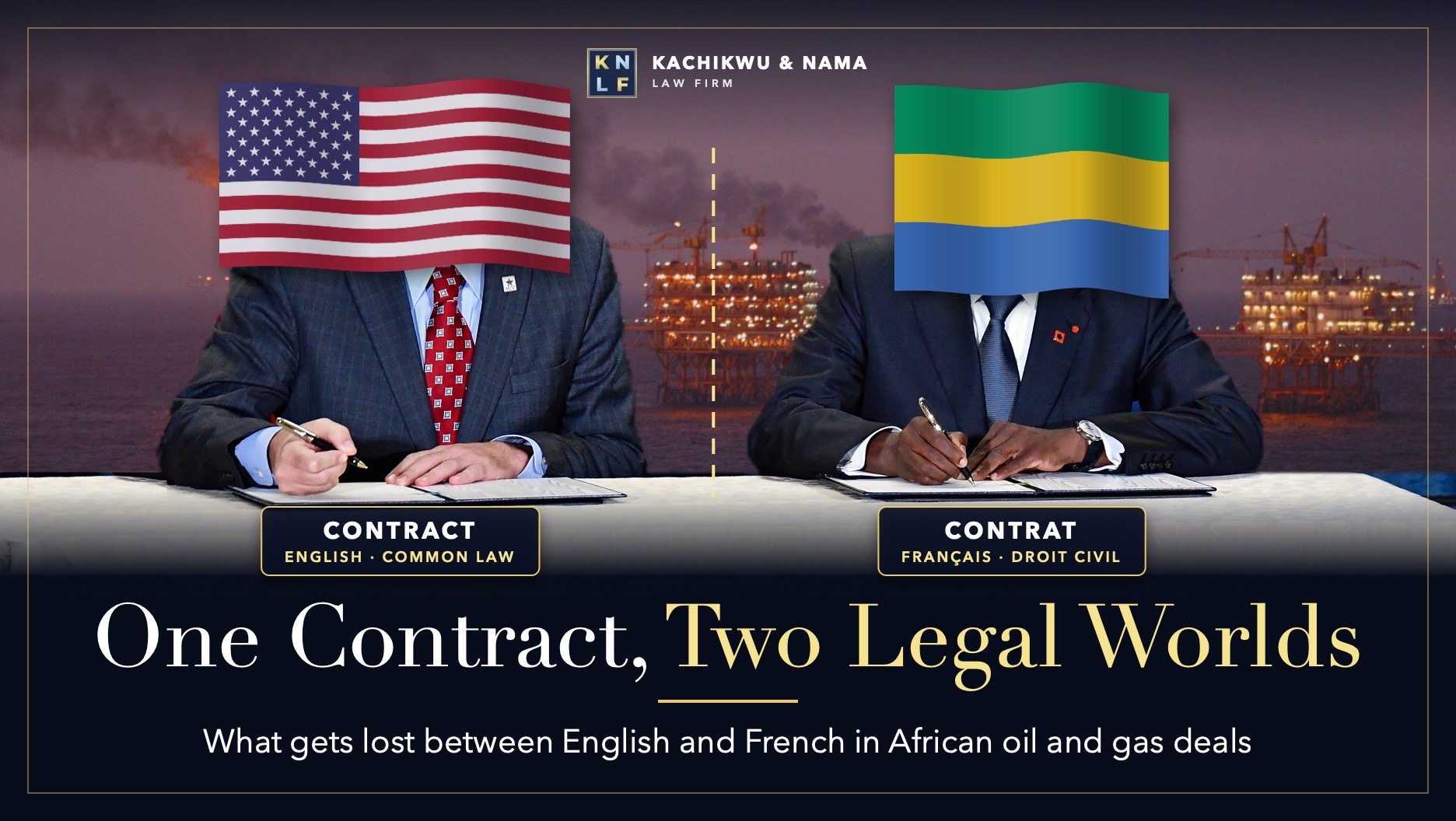
One Contract, Two Legal Worlds: What Gets Lost Between English and French in African Oil and Gas Deals
Picture a negotiating room. An international company and a host government’s team have spent months on a petroleum contract. The English draft says the contractor will use “best efforts” to hire and train nationals and to buy local goods and services. The French version says meilleurs efforts. Both sides nod.
They have not agreed. The company’s lawyers read a serious duty to try, but not a guarantee. The ministry’s lawyers, trained in civil law, ask two questions the phrase does not answer. Is this a firm commitment? Who must prove what if it is missed? Nobody in the room mistranslated anything, yet the two sides left with two different contracts in mind. The scene is invented. The problem is real.
That gap exists in many oil, gas and mining contracts signed between English-speaking companies and French-speaking States. It is usually found late: in a renegotiation, or in a dispute.
Two legal systems, not two languages
The process runs in either direction. Often the State’s model contract is in French and the company works from an English translation. Sometimes the company’s lawyers draft in English and the text is translated into French. Outside counsel then reviews one version or the other. Each person does the job well, and the problem can survive every step, because often no one is asked to read both texts as a lawyer trained in both systems. On the largest projects, international firms do field teams qualified in both traditions. The gap opens more often in joint operating agreements, service contracts, amendments and smaller deals.
Translation works with words, but a contract is made of legal concepts, and many common-law concepts have no twin in the civil-law tradition that French-speaking African countries inherited. The official on the other side of the table studied that tradition. He or she reads the French text through it, and so will a local court or an arbitral tribunal applying local law.
A translator’s task is translation, and good legal translators do it with great skill. But a translator is not asked to carry the legal effect of a clause from one system into another, and cannot be blamed when that effect is lost.
What a cross-border contract needs is counsel who are not only bilingual but also what I call “bilegal”: trained in both legal systems as well as fluent in both languages. Add a third country and the standard rises with it: trilingual and “trilegal.” Language skill without legal training in both systems leaves the real gap open.
In many of these countries the contract is formally approved, often by decree or by law, and in a French-speaking State the text that goes through that process is ordinarily the French one. If it says something different from the English, the French is the text the State approved, and the State is entitled to rely on it.
The law itself has had this problem
The difficulty is not limited to private contracts. It appears in the region’s own business law.
Seventeen African States share one body of business law through OHADA, the Organization for the Harmonization of Business Law in Africa. Its treaty, as revised in 2008, names four working languages: French, English, Spanish and Portuguese. It then adds a rule every English-speaking investor should know: when the translations differ, the French version is the authentic one.
Scholars who have studied the English versions of OHADA’s Uniform Acts report the same thing this article describes. The translations struggle because the concepts underneath them come from civil law and do not match common-law thinking. The States settled the language question in the treaty itself. A contract deserves the same care.
What real contracts say about language
Published petroleum contracts show how differently the question is handled.
A published 2006 production sharing contract between Cameroon and the local subsidiary of a U.S. oil company provides, at Article 31.3, that the contract is in English and French and that both versions are equally binding. That sounds fair, and in bilingual Cameroon it is natural. It also means that if the two texts differ, neither one prevails. The difference must then be settled by interpretation, possibly years later.
Other contracts in the region are signed in French only, with the books kept and any arbitration conducted in French. The English text the investor worked from may then have no legal standing at all. Elsewhere the contract names the prevailing text: Mozambique’s model contract makes both texts binding and says the Portuguese prevails.
There are three possible positions, and each carries a different risk:
| Clause | What it means for the investor |
|---|---|
| French prevails | The text you must understand perfectly is the one your team did not draft. |
| Both equally binding | Any difference between the texts is an open question until a tribunal decides it. |
| English prevails | Comfortable on paper, but the State approved the French, and a court or tribunal applying local law will be shown the French. |
None of these is wrong. Each one tells you where the legal work has to be done before signature.
Ten terms that change meaning on the way to French
These terms appear across upstream contracts: host-government contracts, joint operating agreements, and drilling and service contracts. Each can be translated word for word, and each can then mean something its drafter did not intend.
| English term | Literal French | What changes under civil law |
|---|---|---|
| Best efforts / reasonable efforts | meilleurs efforts | Civil law sorts duties into obligation de moyens (a duty of diligence) and obligation de résultat (a promised outcome). The choice decides what must be proved. Under the first, the other party must prove fault. Under the second, missing the result is enough, unless an outside cause such as force majeure is shown. “Best efforts” names neither, so the contract should say which one is meant. |
| Consequential damages waiver | dommages indirects or consécutifs | French law counts lost profits (manque à gagner) as recoverable loss, and it already refuses indirect loss by default. Common-law courts can also treat lost profits as direct loss. A waiver of “indirect damages” may therefore exclude very little unless it names each head of loss. |
| Gross negligence / willful misconduct | négligence grave / faute intentionnelle | The civil-law concepts are faute lourde and faute dolosive. They are generally treated as limits that no exclusion of liability can cross, so the carve-out must be built around them. |
| Indemnify and hold harmless | indemniser et dégager de toute responsabilité | French has no exact twin for a stand-alone indemnity. It is usually rendered with garantir or tenir indemne, words that carry their own technical meanings, so scope, trigger and procedure must be spelled out. |
| Stabilization / change in law | stabilisation | A contract with the State may be read alongside public-law doctrines such as fait du prince and imprévision. A stability clause has to work with them. |
| Liquidated damages | dommages-intérêts forfaitaires | Common-law courts enforce a fair pre-agreed sum but strike down a penalty; they do not adjust the amount. French law accepts a clause pénale but lets the judge reduce it if it is manifestly excessive, or increase it if it is derisory. Some African States follow that rule and others do not. The same clause is at risk for different reasons in each system. |
| Time is of the essence | les délais sont de rigueur | In the civil-law tradition a party is usually in default only after formal notice (mise en demeure). If the contract intends default without notice, it must say so. |
| Representations and warranties | déclarations et garanties | Civil law has no category of “representation.” A false statement is handled through defects of consent or statutory guarantees. The remedy the parties want must be written into the clause. |
| Force majeure and hardship | force majeure / imprévision | In civil law, force majeure is a legal concept with its own conditions, and hardship is a separate doctrine. A contractual list of events sits on top of both and should say whether it replaces or adds to them. |
| Sole discretion | à sa seule discrétion | Civil-law systems generally impose a duty of good faith in performance. A right described as discretionary may still be reviewed for abuse. Common law is not uniform either: English courts require that a discretion not be used arbitrarily. |
Each term is standard in its own legal system. The difficulty is that the two systems are rarely read together. I wrote about the stabilization row in more detail in Who Carries the Risk When Host Governments Change Laws and Regulations Mid-Project?.
A caution about “French law”
France rewrote its law of contract in 2016. One change matters here. For contracts concluded on or after October 1, 2016, the French Civil Code lets a party that did not accept the risk ask to renegotiate when an unforeseeable change of circumstances makes performance excessively costly. If that fails, a court may revise or end the contract. The parties may exclude that rule or write their own.
That reform applies in France. It did not automatically reach countries whose law grew from the French code. Some, such as Senegal, have long had their own code of obligations. Others apply the Code as it stood at independence, as developed since by their own legislatures and courts. Today’s Paris rule is not automatically the rule in every French-speaking African country, and the difference can run in either direction.
The practical lesson is the same as before. The French text must be read under the law of the country that will apply it, by someone trained in that tradition.
What the gap costs
Money. Project teams watch budget and schedule. The usual process is hard on both. The client can pay for the same contract several times: once to the lawyers who draft it, once to the translation company, once to the outside counsel who reviews the result, and again for each round of rework when the versions are found to differ.
A “bilegal” firm can save much of that money. It does not bill translation as a separate service. The work it charges for is the legal work, and the second-language text comes out of that same work, already carrying the right legal meaning. One engagement can take the place of the translation invoice, the second review and much of the rework, and the contract can reach signature sooner. Local counsel remain essential, and the actual saving depends on the contract.
Time. When the two sides read a clause differently, they negotiate without understanding each other. Each round of comments answers a point the other side did not make. Contracts that should close in months take longer, and neither side can quite say why.
Trust. A party that finds its text does not match what was agreed in the room may suspect more than a translation gap. That suspicion is hard to repair, and it affects every later request between the two sides.
Disputes. Years later, when a cost is disallowed or a tax changes, each party opens its own version and finds its own answer. If the contract says the French text prevails, the company’s reading may not be the one that governs.
The costs fall on the State as well. A ministry that signs a clause it understands differently from its partner carries the same risk in reverse. Clear drafting protects both signatures.
The same problem in Portuguese
Nothing here is unique to French. Angola and Mozambique work in Portuguese, within a Portuguese-derived civil-law tradition. An English-language contract negotiated in Luanda meets the same gap: matching words, different legal categories, and a Portuguese text that is the official one. Angola’s 2025 model production sharing contract states that the Portuguese text is the only official text.
This article stays with French because that is where most of the examples above come from. The method is the same in any language pair, and our firm is able to do this work in other languages as well, Portuguese included.
Before you sign: nine checks
- Settle the governing language early. Find out first whether the model contract or local practice already fixes the language of the contract or the prevailing text (la version faisant foi). If it does not, negotiate it as a real term, not boilerplate.
- Find out which text the State approved. Where a contract is approved by decree or by law, ask which language version was attached. That version is the one the State will defend.
- Annex a binding bilingual glossary. Define each key term once, in both languages, and state that it carries the same meaning in both versions. If the French text prevails, the glossary is how the English meaning travels with it.
- Draft the two versions together. If the State’s model is in French, negotiate from the French and build the English from it. If you draft first, draft both together. A second-language text produced after the first is final inherits every ambiguity.
- Name the civil-law category. For each important duty, say whether it is an obligation de moyens or an obligation de résultat, in both versions.
- List the losses. In any limitation of liability, name each head of loss, and say that it is excluded whether it is called direct or indirect.
- Build the carve-outs on local concepts. Use faute lourde and faute dolosive where the English says gross negligence and willful misconduct, and check how local law treats them.
- Match the dispute clause to the language clause. Decide the language of the arbitration and which version the tribunal will work from. Read the language clause together with the governing-law and stabilization clauses: the tribunal, its seat and the applicable law decide whose reading of the French text counts. A contract whose French text prevails but whose arbitration runs in English invites a dispute over translation at the worst moment.
- Have both texts read as one. Before signature, someone trained in both legal systems should read the English and the French as a single contract, alongside local counsel, and confirm the two say the same thing.
One contract, one meaning
A contract in two languages should still be one agreement. When it is, the company signs what it intends and the State recognizes what it signed.
Before you sign, know the law on both sides of the table, or be advised by someone who does.
Georges C. Nama, Esq., is Co-Founder and Managing Partner of Kachikwu & Nama Law Firm, LLP, in The Woodlands, Texas. He trained in the French civil-law tradition, is licensed in Texas, and advises investors on oil, gas and mining deals between the United States and Africa. The firm can be reached at +1 (832) 840-7266 or [email protected]. This article is general information, not legal advice, and reading it does not create an attorney-client relationship. The law differs from country to country, and each contract should be reviewed on its own terms.
Further reading and sources
- Who Carries the Risk When Host Governments Change Laws and Regulations Mid-Project?
- KNLF Oil & Gas Lexicon
- OHADA Treaty as revised in 2008, Article 42
- Nelson Enonchong, The Harmonization of Business Law in Africa: Is Article 42 of the OHADA Treaty a Problem?, Journal of African Law (2007)
- Jean-Jacques Ndongo, Les actes uniformes de l’OHADA en traduction, Parallèles (2013)
- Production sharing contract, Republic of Cameroon (2006), Article 31.3, ResourceContracts.org
- Bird & Bird, French contract law reform (on Article 1195 of the French Civil Code)
At KNLF, we draft, negotiate and review cross-border contracts in English and French, and in Portuguese, as one agreement: host-government contracts, joint operating agreements, service contracts and amendments, in oil, gas & energy, contract drafting and negotiation, OHADA law and Africa–U.S. transactions. We also serve as outside general counsel when you want that reading done on every deal. Book a consultation before you sign a contract in two languages.
Every Monday, we break down Africa–U.S. oil and gas news in the Oil & Gas Intelligence Brief, and we publish deal-side guidance in Before You Sign.
Comments
Join the discussion. Comments are reviewed by the firm before they appear.
No comments yet. Be the first to share your perspective.